Showing posts with label antique n ancient. Show all posts

Sunday, April 4, 2010

Lather, Rinse, Repeat: Crazy 70s Human Washing Machine


Did you ever climb into the clothes dryer as a kid? Did you ever want to try the washer? If you lived in 1970s Japan, you might have gotten a brief chance. Sanyo displayed a suite of futuristic electronics in the 1970 World Expo in Osaka; the examples were meant to show off what the home of the future would be like. One of the most fascinating gadgets was their Ultrasonic Bath.

The bath consists of an egg-shaped chamber six feet off of the ground that contained a chair. After the user climbed a ladder to enter the chamber, a pre-rinse cycle sprayed the body with jets of water. The machine then moved on to a massage bath mode, ultrasonic cycle, and a rinse. After the user was thoroughly sanitized, the gizmo entered the dry cycle, complete with special lights to blast away germs.

Sadly, the Ultrasonic Bath never actually made it to production. It’s just wacky enough to make it seem cool, even by today’s standards. And with its funky 1970s styling, it would undoubtedly be the most stylish thing in your home – whether you decided to keep the bathing suit or go au naturale.

Epic Fails: 10 of the Dumbest Inventions of the 20th Century

dumb inventionsMost great inventions are called “dumb” or “silly” or “useless” for a while before they actually take off. The personal computer, for example, was said to be a pointless invention that no one would ever want – and now just about every home in the developed world has one. But not all inventions are winners – some really are dumb, silly or useless. Here are a few of the worst inventions of the 20th century.
motorized surfboard
Back in 1948, there was apparently nothing weird about riding across a lake on a motorized surfboard while wearing a nice suit and bowler hat and smoking a cigarette. Forget his lack of safety gear – inventor Joe Gilpin looks cool gliding along on the water.
flying platform
This invention was only dumb because the Green Goblin stole it and used it to terrorize New York City. This flying platform was developed for the military, and in this picture it’s being tested at an Air Force base.
phone answering robot
A machine that answers the phone? Genius! Except…this one couldn’t talk, play a greeting or record the caller’s voice. So, really, it was more like a phone-picking-up machine.
suspended baby cage
Humans in the 1930s had a much higher infant mortality rate than the one we experience today, and we think we’ve found the reason: inventions like this insane baby cage that suspends your precious bundle of joy out of the window, high above the very hard pavement below.
ice skating baby holder
This is another example of superb 1930s parenting: a baby carrier suspended between two parents. It seems slightly risky, but not like the most dangerous thing ever…until you realize that the parents in question are ice skating.
shower hood
This shower hood from 1970 has us baffled. Is it meant to keep your head dry while you shower? Or does it let you just wash your hair while your face stays dry? Either way, we commend this model for being able to smile while standing naked in front of a photography crew while wearing a beekeeper’s hood.
honegar
Speaking of bees, honey is a well-loved folk remedy and has been for centuries. Vinegar is also used often to treat various conditions. But mixing the two together resulted in Honegar, which we can’t imagine even trying to stomach.
sea shoes
Seriously, what was up with guys playing in the water while wearing suits? At least M. W. Hulton’s invention included poles to help the rider with balance. The duckfoot propellers on the back of these Sea Shoes helped the well-dressed man traverse all of the pesky ponds between home and work.
cigarette pack holder
In the 50s, everyone smoked. In fact, they couldn’t smoke fast enough if this cigarette pack holder is any indication. Did the inventor of this fine contraption not know that excess nicotine causes violent vomiting, dizziness and severe headache?
cigarette holder for two
(all images via: Life)
The cigarette holder for two: for when you really want to share your lung cancer with the one you love.

Blown Opportunity: New York City’s Failed Pneumatic Trains


Bad timing and politics have ruined more than their fair share of great ideas, including New York City’s first underground train system. The pneumatic system was developed by Alfred Ely Beach in the late 19th century and the first demonstration was carried out beneath Broadway in 1870. The Beach Pneumatic Transit System never realized its potential, though, after being derailed by political interests and the Long Depression of the 1870s. It’s an interesting piece of New York mass transit history that was well before its time and suffered an undignified death.

The concept was admirably simple, and familiar to anyone who has used the drive-through lane at a modern bank: powerful rushes of air moved cars along an underground tube. Beach’s permit to build an experimental tube underground only gave him clearance for developing a package delivery system, so the passenger system that he was working on was developed rather clandestinely. Due to pressure from politicians who were investing in competing technologies, Beach never secured permission to extend the tunnel into a full-blown operational pneumatic railway.

But for the few months that it was in existence, the underground system was mightily impressive. The 95-meter-long tunnel ferried passengers between Broadway and Murray Street at night; because the tunnel itself was so fascinating to New Yorkers, it was open for walking tours during the daylight hours. Elevated trains gained favor because of their lower cost, but eventually the New York transit system moved underground. The death of the idea came about partially because New York Governor John Hoffman vetoed any measure to build underground tunnels, partially because landowners were afraid of possible damage to their buildings, and partially because the American economic system all but collapsed in 1873. The tunnel, station and carriage associated with Beach’s line have all been destroyed over the years.

Just Your Type: 11 Gorgeous Unique Antique Typewriters


The  QWERTY keyboard setup is pretty familiar to us today, but before it became the standard for English-language keyboards there were plenty of other layouts that never quite caught on. Old typewriters often feature bizarre mechanisms and uncomfortable-looking keyboard configurations, but their divinely unique layouts are what makes them so fun to look at today. These pictures and the related information are all from the Howard Martin Collection of Early Typewriters, the largest collection of its kind in Canada.

When typewriters were new, manufacturers experimented with the most efficient mechanisms and layouts. They all hoped to edge ahead of the competition with a product that was easier to use than the others, but many of them ended up creating typewriters that were confusing or difficult. The machines above required users to lift the large top pieces in order to see what they’d typed.

Index typewriters were very popular in their time, but would probably be too confusing for typists today. One hand moved the pointing device to the desired character, then the other hand pushed a button to move the tape onto the paper, leaving the imprint of that character there.

The Hall was the world’s first index typewriter, built in New York in 1881. One of the best features of the index typewriter was the ease with which one could change fonts and character sets. When it was released, it sold for a reasonable $40 while other typewriters were in the $100 range.

Some antique typewriters are so bizarre looking that they are barely recognizable as typewriters today. But as manufacturers came up with ideas for the layout of their machines, each one inevitably thought they’d developed what would become the universally accepted typewriter style. Of course, the vast majority of them were ultimately wrong.

The Odell 2 was one of the most beautiful typewriters of its time. It featured unique Art Nouveau style and a strange index typing mechanism that most people would find too tedious to use today.

Not all antique typewriters were laughably inefficient or difficult to use. These machines, made by the Hammond Typewriter Company in the late 19th century, were absolutely beautiful and simple to type on, and they produced great results. They may have been a bit opulent for the everyday person, though, being made of mahogany and ebony.

Fantastic Flops: Four Failed Gadgets That Time Forgot


As technology evolves, there are bound to be some bumps in the road; some gadgets which seem like a great idea at the time, but are eventually revealed to be epic flops. These four antique gadgets were at the cutting edge of technology when they were released, but never quite managed to become household names.

What better cure for the common head cold than a healthy dose of radiation? This scary-looking apparatus enclosed the head in a metal drum and doused it with ultra-violet rays. The Solar Bath Apparatus was meant to clear up catarrh of the ears, nose and throat, along with other head-related illnesses.

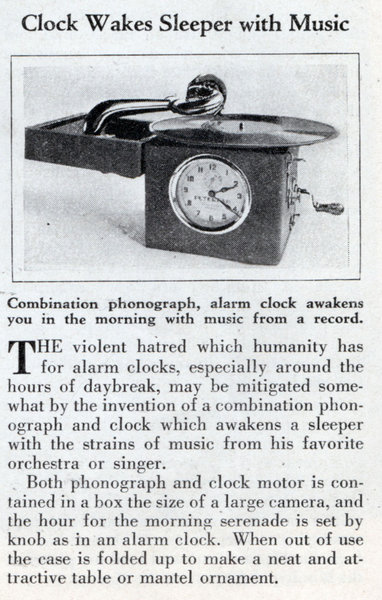
Nobody likes waking up to the beeping or buzzing alarm clock, so some clever inventor decided to rig an alarm clock with a phonograph. Obviously, the phonograph wasn’t fated to enjoy a long and healthy life, and it fell out of use before the phonograph alarm clock really took off. The concept itself wasn’t exactly a complete failure, though – many of us wake up today to a CD in the alarm clock.

In the 1950s, UFO sightings were being reported at a frenzied pace. In an attempt to weed out the obvious fakes, the Flying Saucer Camera was developed. One of its lenses took a normal picture, and the other separated the light in the picture into individual colors. The separation allowed authorities to easily discern the origins of the UFO in the photograph.

When antiques attack : 3 ridiculously dangerous old Gizmos


Some people think that today’s safety concerns are out of control. But when you look back at the insanely dangerous products that used to be marketed and sold, modern safety regulations kind of make sense. Take the Shoe-Fitting Flouroscope for example: the shoe-fitting device was common in shoe stores from the 1930s to the 1950s, when it was deemed too dangerous. Shoppers stuck their feet into an opening in the bottom of the box, and the shopper, salesperson, and a third person (presumably the parent of a young shoe shopper) could look into the box through the openings in the top.

It all sounds innocent enough, but the bottom of the box contained an X-ray tube to show salespeople the bone structure of the foot. Today, we know that constant X-ray exposure isn’t good for anyone’s health. No shoppers were injured by the device, but an unfortunate model who demonstrated the device did receive serious radiation burns that required the amputation of one foot. It wasn’t until the 1950s that the machines were removed from shoe stores in the US, with the UK following suit in the 1970s.

Even the man in the diagram explaining this terrifying device looks unsure of its safety. The hair-singeing device was invented by John Boax in 1951, and was a godsend for everyone with a fear of scissors slicing through their locks. It substituted heat for scissors: hair was sucked up into the chamber and burned off at the desired length by hot electric coils. Boax was granted a patent for his creation, but not surprisingly, it never really caught on.

While the device isn’t as popular as it once was, the teasmade was used at the bedside in most homes across the UK. Much like modern coffee machines with timers, the teasmade could be programmed to have some piping hot tea ready first thing in the morning. This 1902 version of the teasmade used an alarm clock, a match, and a portable stove to make a very dangerous cuppa. When the alarm clock sounded, the mechanism struck a match across sandpaper to light the spirit stove. Steam from the boiling water caused the tiny kettle to tip, pouring hot water into the waiting cup or teapot below. Aside from the device lighting something on fire inches from one’s head while one is asleep, we can’t imagine why this method is no longer used.

It’s About Time: Multifunctional Antique Pocket Sundials


Most of us tell time these days by looking at a watch strapped to a wrist or by pulling a cell phone out of a pocket. But the timepieces from centuries ago were much more interesting. The one above is from 16th century Germany and now resides in the Beyer Watch and Clock Museum in Zurich. It’s a multifunctional piece that included a gunpowder flask, compass and sundial. The rosewood flask is decorated with ornaments of brass and bone, and at the top is the bone funnel used to insert the gunpowder. Beneath the small lid in the center of the piece is a sundial; a string gnomon is exposed by opening the lid and can tell the hours from 6 am to 6 pm.

This gold-plated brass sundial was made in the same time period as the above multifunctional pocket sundial, but it’s missing the compass that used to be part of its design. It was excavated in 1997 at the former site of the Mission de Santa Cruz San Saba in Texas. The mission was destroyed by attacking Native Americans in 1758, but the sundial was made 177 years prior, making it a valuable heirloom even then. Why it was left behind and not taken as a prize is a mystery, but it’s lucky for us that the fascinating gadget was left behind for future generations to admire and study.